W13. Planarity and Coloring
1. Theory
1.1 Planar Graphs
1.1.1 Definition of Planar Graphs
A planar graph is a graph that can be drawn on a flat surface (a plane) in such a way that no edges cross each other, except at their endpoints (vertices). This special drawing is called a plane embedding (or planar embedding) of the graph.
The key insight is that a graph being planar is an intrinsic property of the graph itself—it doesn’t matter how the graph is initially drawn. If you can somehow redraw it without crossings, then it’s planar. Many graphs that appear to have crossing edges can actually be redrawn to eliminate those crossings.
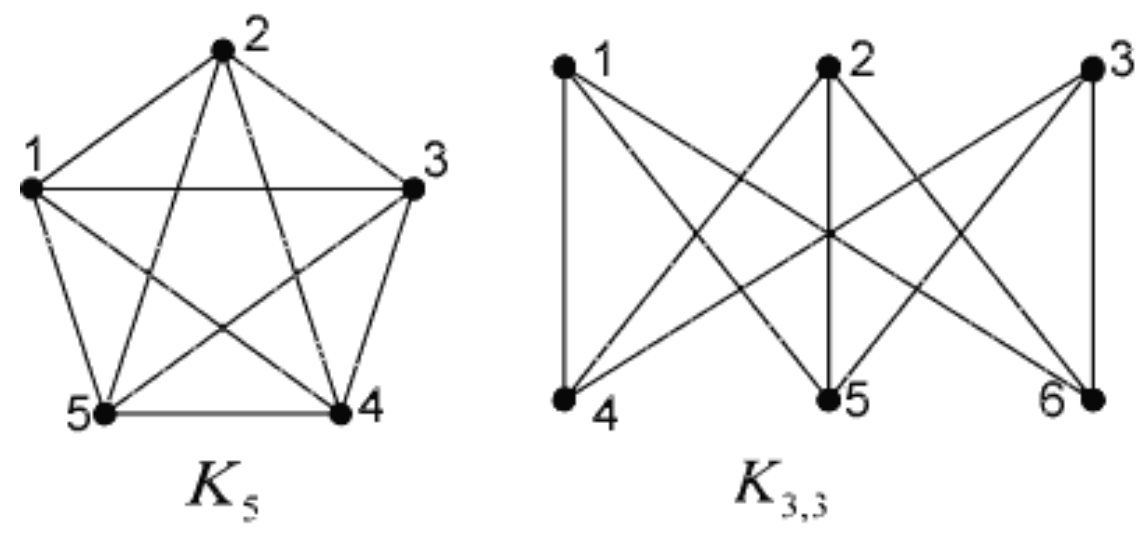
For example, the complete graph
1.1.2 Examples of Planar and Non-Planar Graphs
Complete Graphs
The complete graph
Complete Bipartite Graphs
The complete bipartite graph
1.2 Euler’s Formula
1.2.1 Faces of a Plane Graph
When a planar graph is drawn on a plane without crossings, it divides the plane into regions called faces. A face is a region bounded by edges. This includes:
- Interior faces: The bounded regions enclosed by edges
- Exterior face (or infinite face): The unbounded region outside the graph
For example, a triangle drawn on a plane has exactly 2 faces: one interior face (the region inside the triangle) and one exterior face (everything outside).
1.2.2 Euler’s Formula Statement and Proof
Euler’s Formula is a fundamental relationship for connected planar graphs:
where:
Proof by Induction on the Number of Faces:
Base Case (
Inductive Step: Assume the formula holds for all plane embeddings with fewer than
Consider a plane embedding
When we remove this edge
By the induction hypothesis:
Since
Thus, Euler’s formula holds. ∎
1.2.3 Euler’s Formula for Convex Polyhedra
Euler’s formula also applies to convex polyhedra (3D shapes with flat faces). The surface of any convex polyhedron can be “flattened” into a planar graph, so:
where
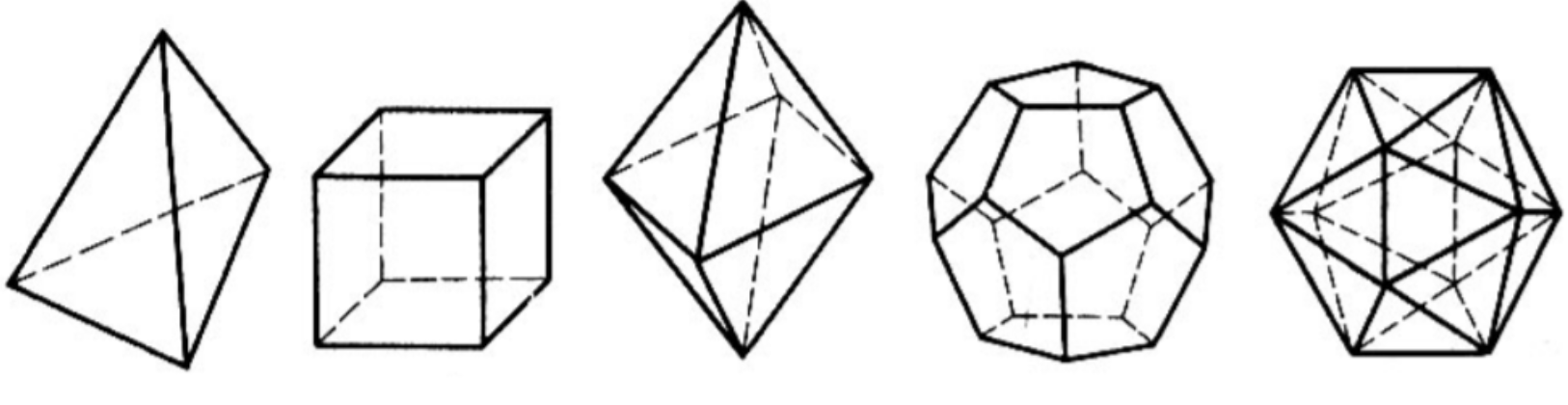
Examples with the five Platonic solids:
- Tetrahedron:
- Cube (Hexahedron):
- Octahedron:
- Dodecahedron:
- Icosahedron:
1.3 Corollaries of Euler’s Formula
1.3.1 Edge Bound for Planar Graphs
Corollary 1: If
Proof: Each face is bounded by at least 3 edges (since a face must form a cycle of at least length 3). Each edge can border at most 2 faces. Therefore:
From Euler’s formula,
Important: This is a necessary condition for planarity, not a sufficient one. A graph can satisfy
1.3.2 Proving
Corollary 2:
Proof: For
If
But
1.3.3 Proving
Corollary 3:
Note: We cannot use Corollary 1 directly here. For
Proof: For
If
Since
So:
This is false! Contradiction. Therefore,
1.4 Kuratowski’s Theorem
1.4.1 Subdivision of a Graph
An edge
Intuitively, subdividing an edge just adds a “bend point” in the middle of an edge—it doesn’t fundamentally change the structure of the graph.
Key Lemma: A graph is planar if and only if all of its subdivisions are planar.
This makes sense: adding points along edges doesn’t create or remove crossings.
1.4.2 Kuratowski’s Theorem Statement
Kuratowski’s Theorem provides a complete characterization of planar graphs:
A graph is planar if and only if it does not contain a subgraph that is a subdivision of
or .
In other words:
- If you can find a subdivision of
- If no such subdivision exists, then the graph IS planar
This theorem tells us that
1.5 Graph Colourings
1.5.1 Definition of Graph Colouring
A
A colouring is called proper if no two adjacent vertices have the same colour. That is, for every edge
A graph
1.5.2 Chromatic Number
The chromatic number
Special cases:
1.5.3 The Four Colour Theorem
Four Colour Theorem: Every planar graph is 4-colourable.
This famous theorem states that
1.5.4 Bipartite Graphs and 2-Colouring
Theorem: The following are equivalent:
- All cycles in
This means a graph can be 2-coloured (using just two colours) if and only if it contains no odd-length cycles. This is because in a bipartite graph, we can colour one partition with one colour and the other partition with another colour.
1.6 Graph Searching Algorithms
1.6.1 Depth-First Search (DFS)
Depth-First Search (DFS) is a graph traversal algorithm that explores as far as possible along each branch before backtracking.
Algorithm:
- Start at an arbitrary vertex (mark it as visited)
- From the current vertex, move to an unvisited adjacent vertex
- Repeat step 2 until no unvisited adjacent vertices exist
- Backtrack to the previous vertex and try other unvisited neighbors
- Continue until all reachable vertices are visited
DFS explores “deep” into the graph first, only backtracking when it reaches a dead end.
1.6.2 Breadth-First Search (BFS)
Breadth-First Search (BFS) is a graph traversal algorithm that explores all neighbors at the current depth level before moving to vertices at the next depth level.
Algorithm:
- Start at an arbitrary vertex (mark it as visited)
- Visit all unvisited neighbors of the current vertex
- Move to the next “level” and visit all unvisited neighbors of those vertices
- Continue level by level until all reachable vertices are visited
BFS explores the graph in “layers” or “waves” emanating from the starting vertex.
Application: BFS can be used to prove that a graph is bipartite (2-colourable). If during BFS traversal we can assign alternating colours to successive levels without conflicts, the graph is bipartite.
2. Definitions
- Planar Graph: A graph that can be drawn on a plane without any edges crossing except at their endpoints.
- Plane Embedding: A specific drawing of a planar graph on a plane with no edge crossings.
- Face: A region bounded by edges in a plane embedding, including the unbounded exterior face.
- Exterior Face (Infinite Face): The unbounded region outside all edges in a plane embedding.
- Subdivision: A graph obtained by replacing edges with paths through new intermediate vertices.
- Proper Colouring: A colouring where no two adjacent vertices share the same colour.
- Chromatic Number
- Depth-First Search (DFS): A graph traversal that explores as far as possible along each branch before backtracking.
- Breadth-First Search (BFS): A graph traversal that explores all vertices at the current depth before moving to the next depth level.
- Bipartite Graph: A graph whose vertices can be divided into two disjoint sets such that every edge connects a vertex in one set to a vertex in the other set.
3. Formulas
- Euler’s Formula (Planar Graphs):
- Edge Bound for Planar Graphs: If
- Edge Bound for Bipartite Planar Graphs: If
- Face-Edge Inequality (General):
- Face-Edge Inequality (Bipartite):
- Chromatic Number of Complete Graph:
- Chromatic Number of Null Graph:
- Chromatic Number of Bipartite Graph:
- Chromatic Number of Odd Cycle:
- Chromatic Number of Even Cycle:
- Four Colour Theorem:
4. Practice
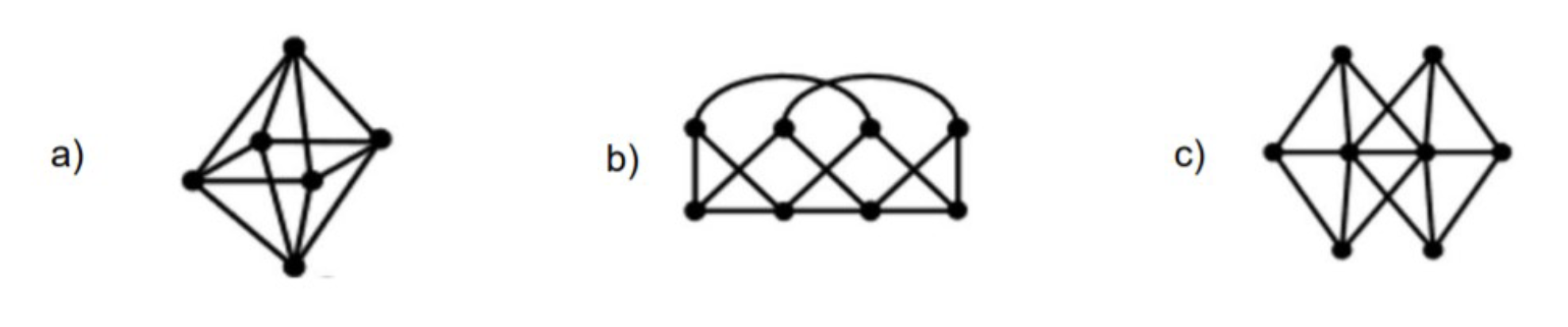
4.1. Show That Graphs Are Planar (Lab 11, Task 1)
Show (draw) that the following graphs are planar:
Click to see the solution
!addsolution
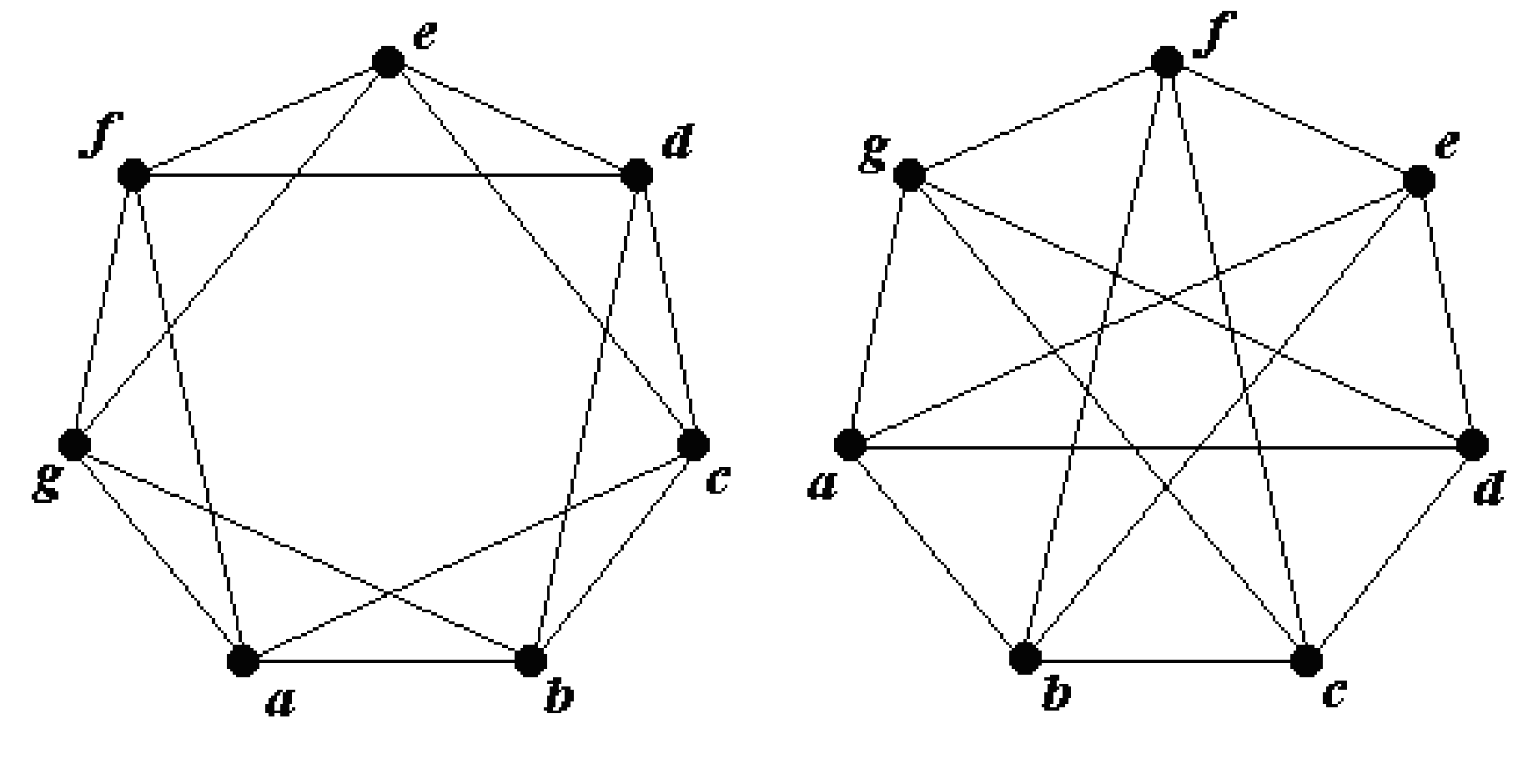
4.2. Determine Planarity of Two Graphs (Lab 11, Task 2)
Are the following graphs planar? Explain your answer.
Click to see the solution
!addsolution
4.3. Prove
Prove that
Click to see the solution
Key Concept: Removing any edge from
- Properties of
- Vertices:
- Edges:
- Vertices:
- Check edge bound:
- Construct planar embedding:
- Label vertices as
- Without loss of generality, assume edge
- Draw vertex 1 in the center of a square formed by vertices 2, 3, 4, 5
- All edges from vertex 1 to 3, 4, 5 can be drawn inside
- The edges 2-3, 3-4, 4-5, 5-2, 2-4, 3-5 form the outer structure
- Since edge (1,2) is missing, no crossing occurs
- Label vertices as
- Verify no
Answer:
4.4. Prove
Prove that
Click to see the solution
Key Concept: Removing any edge from
- Properties of
- Vertices:
- Edges:
- Vertices:
- Check edge bound for bipartite graphs: For bipartite graphs (no odd cycles):
- Construct planar embedding:
- Let the two partitions be
- Without loss of generality, remove edge
- Draw
- Arrange other vertices to form a planar layout:
- Place
- Draw remaining 8 edges without crossings
- Place
- Let the two partitions be
- Why it works:
- Removing one edge brings it exactly to the boundary
- The removed edge eliminates the “conflict” that caused non-planarity
Answer:
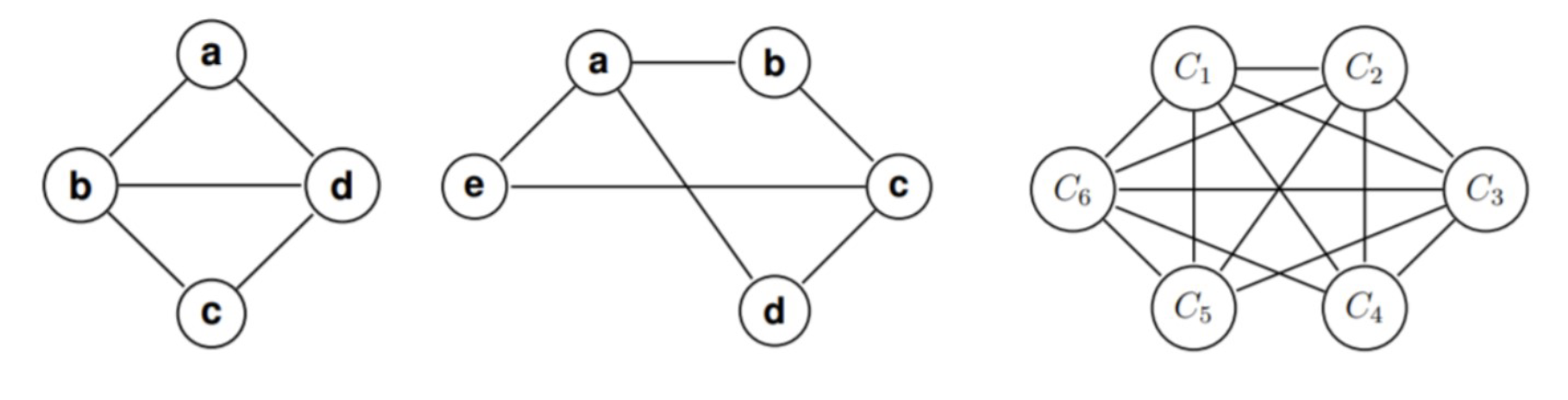
4.5. Find Chromatic Numbers (Lab 11, Task 5)
Find the chromatic number of the following graphs:
Click to see the solution
!addsolution
4.6. Simple Planarity Check (Tutorial 11, Task 1)
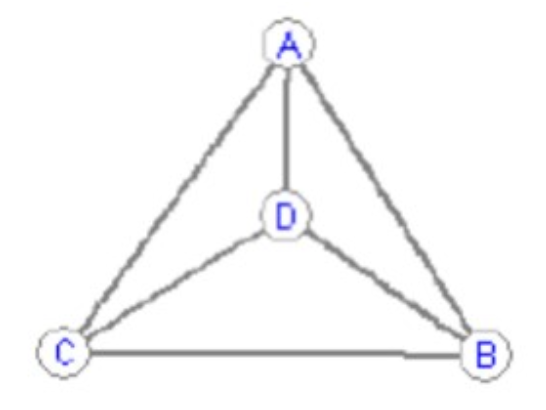
Is the following graph planar? A “diamond” shaped graph with 4 vertices and crossing internal edges.
Click to see the solution
Key Concept: Redraw the graph to eliminate crossings.
- Original drawing: A diamond with 4 vertices and a vertical and horizontal line through the center, creating crossings.
- Redraw without crossings:
- Keep the diamond shape (4 outer edges)
- One internal edge (say vertical) stays inside
- The other internal edge (horizontal) is drawn as a curve going around the outside of the diamond
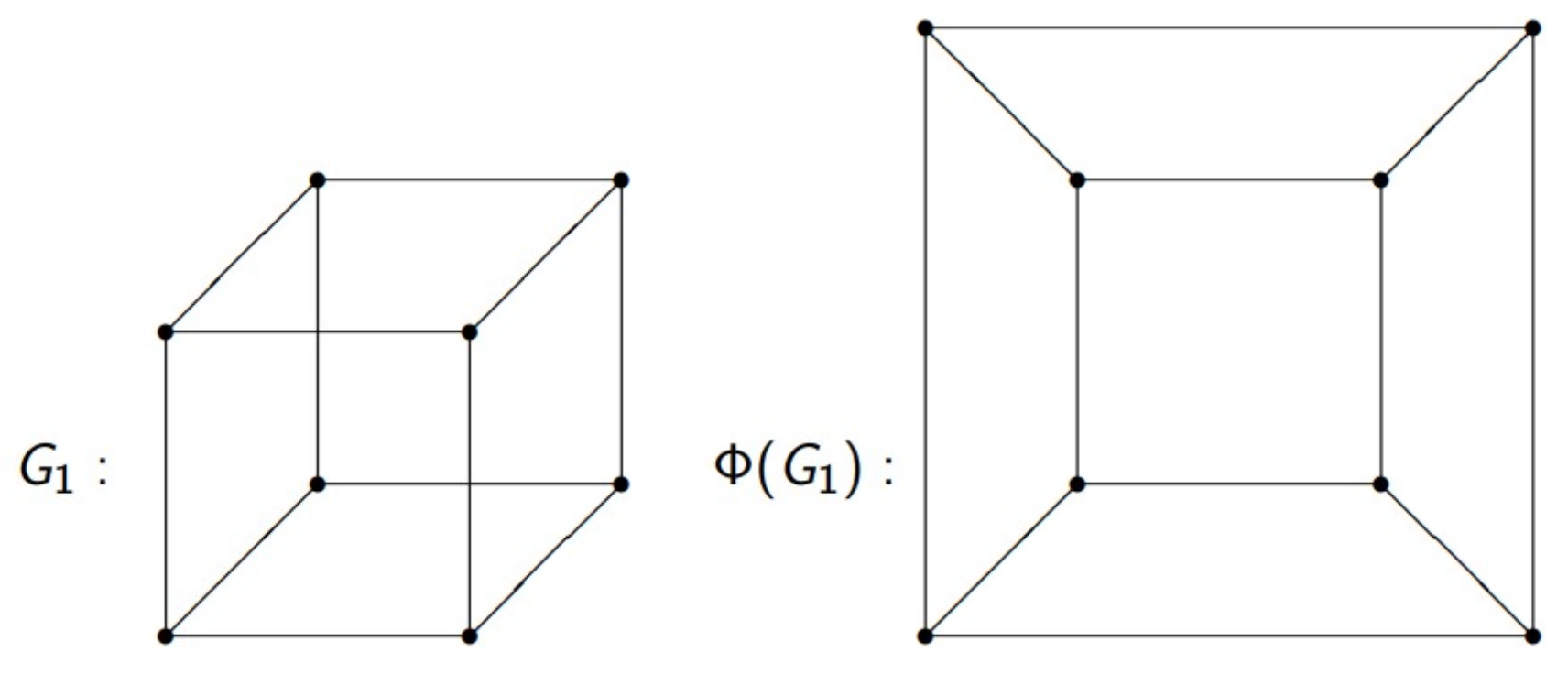
- Result: The graph can be embedded in the plane without crossings.
Answer: Yes, the graph is planar.
4.7. Planarity of
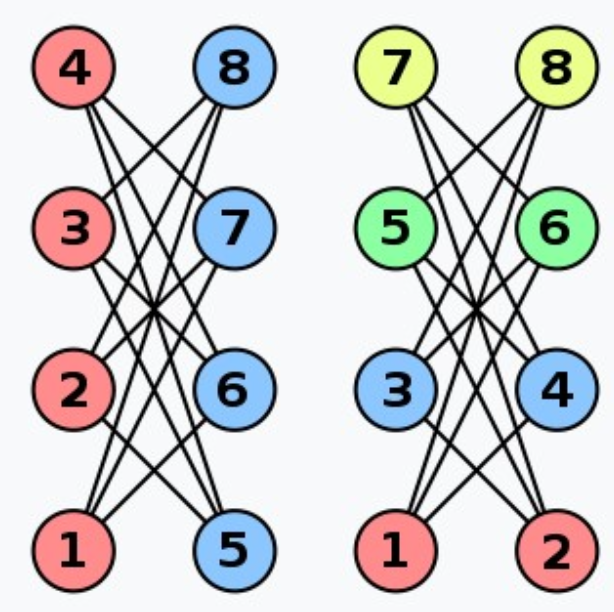
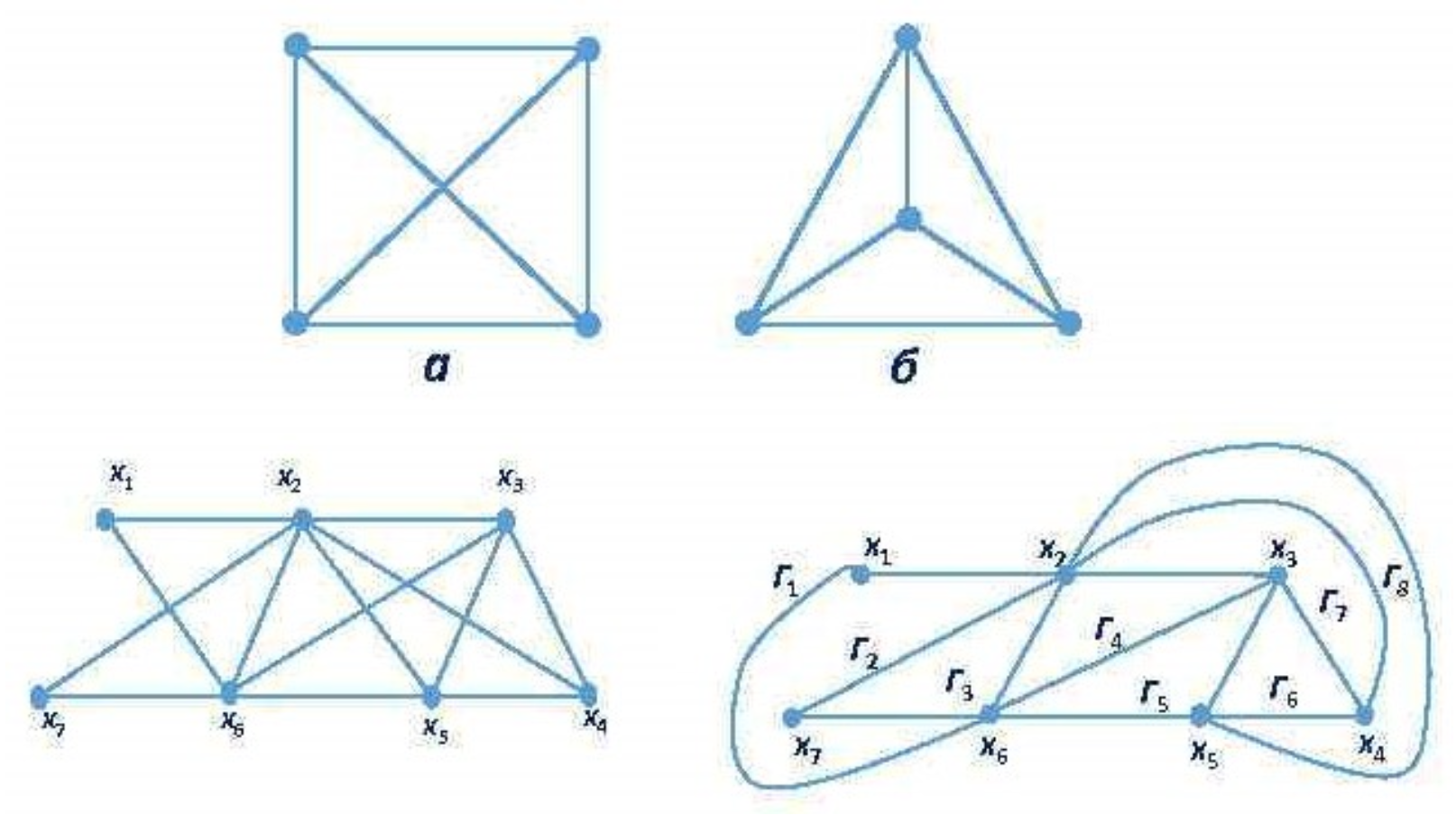
Is the complete bipartite graph
Click to see the solution
Key Concept:
- Structure:
- Check edge bound:
- Construct planar embedding:
- Place one vertex from the first partition (a) at the center
- Place the other vertex from the first partition (b) outside
- Arrange the three vertices (c, d, e) of the second partition in a triangle around a
- Draw edges from a to c, d, e inside the triangle
- Draw edges from b to c, d, e going around the outside
- Result: No crossings needed.
Answer: Yes,
4.8. Planarity of 8-Vertex Grid Graph (Tutorial 11, Task 3)
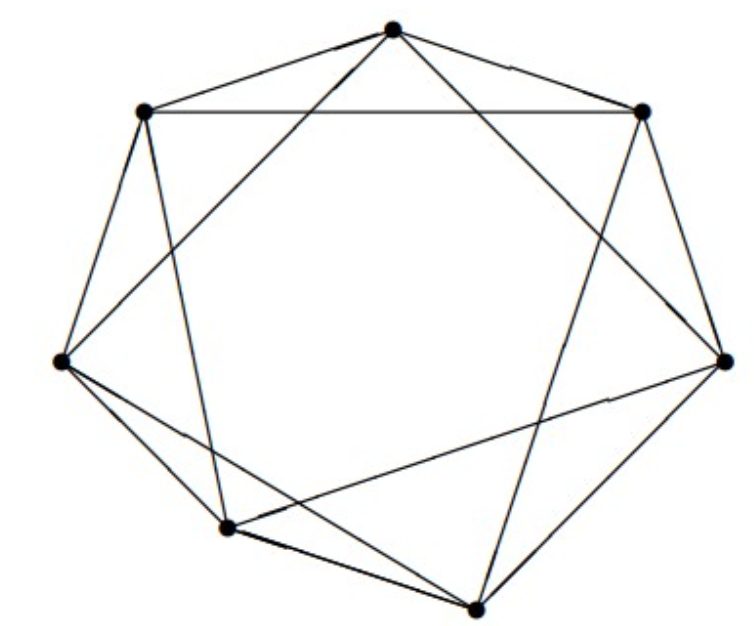
Is the following graph planar? A graph with 8 vertices in two columns of 4, with many crossing edges.
Click to see the solution
Key Concept: This graph represents a cube’s edge structure, which is planar.
- Identify the graph: 8 vertices arranged in a 2×4 pattern with specific connections.
- Recognize as cube graph: The graph is isomorphic to the edge graph of a cube (3-dimensional hypercube
- Construct planar embedding:
- Draw as a “box within a box” (nested squares)
- Outer square: vertices 1, 2, 6, 5
- Inner square: vertices 7, 3, 4, 8
- Connect corresponding vertices between squares
- Result: The cube graph is planar.
Answer: Yes, the graph is planar and can be drawn as nested squares.
4.9. Comparing Cube and Modified Cube (Tutorial 11, Task 4)
Which of the following graphs are planar?
Click to see the solution
- The cube graph is well-known to be planar.
- Planar embedding: Draw as nested squares (inner square inside outer square) with 4 edges connecting corresponding corners.
Answer for
- Analyze additions: The extra edges create more connectivity.
- Search for
- Label vertices appropriately
- Identify two sets of 3 vertices each:
- Find paths connecting every
- The extra diagonal and curved edge provide the necessary connections
- Finding the subdivision:
- The vertices can be partitioned to show 9 paths between two sets of 3
- Some paths go through intermediate vertices (
Answer for
4.10. Chromatic Number of Bipartite Graph (Tutorial 11, Task 5)
What is the chromatic number of a bipartite graph with 8 vertices (4 on each side)?
Click to see the solution
Key Concept: Bipartite graphs are always 2-colourable.
- Property of bipartite graphs: Vertices can be partitioned into two sets where edges only go between sets, not within sets.
- Colouring strategy:
- Assign colour 1 to all vertices in the left partition
- Assign colour 2 to all vertices in the right partition
- Verification: Since no edges exist within a partition, no two adjacent vertices share a colour.
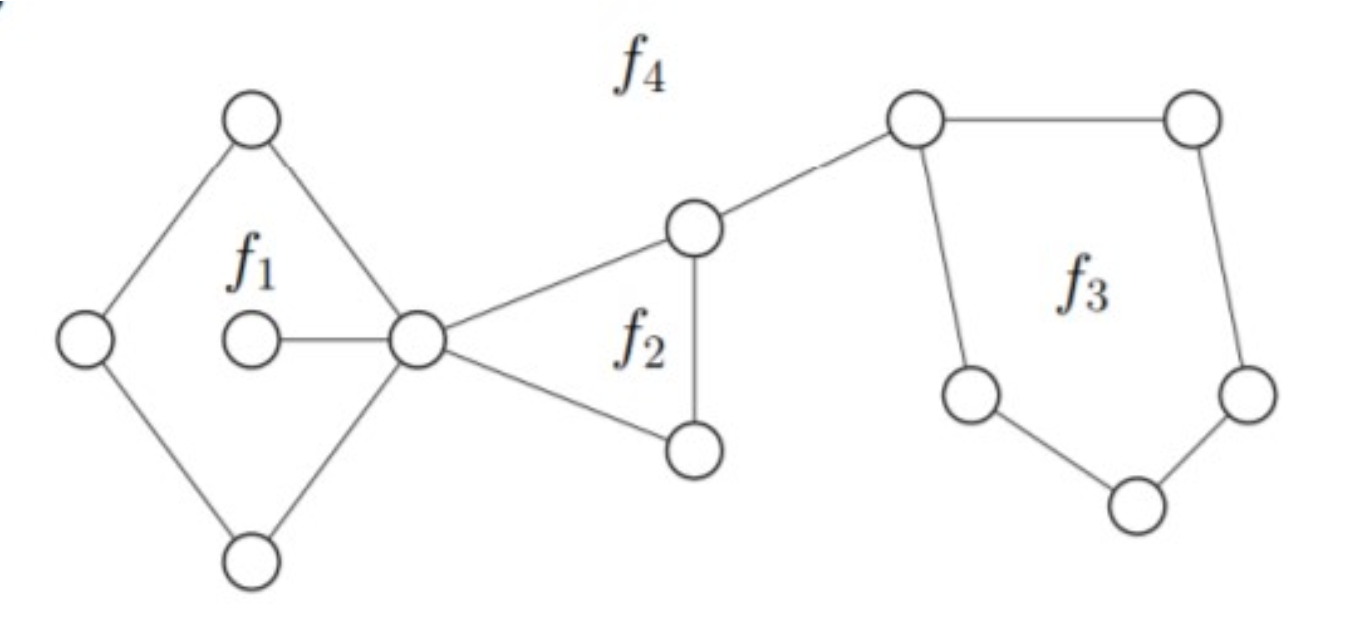
Answer:
4.11. Chromatic Number of Pentagon (Tutorial 11, Task 6)
What is the chromatic number of a pentagon graph (cycle
Click to see the solution
Key Concept: Odd cycles require 3 colours; even cycles require 2 colours.
- Structure:
- Why 2 colours fail:
- Start: A = colour 1
- B is adjacent to A: B = colour 2
- C is adjacent to B: C = colour 1
- D is adjacent to C: D = colour 2
- E is adjacent to D: E = colour 1
- But E is also adjacent to A, and both have colour 1!
- Contradiction: 2 colours insufficient.
- 3-colouring works:
- A = 1 (Red)
- B = 2 (Green)
- C = 1 (Red)
- D = 2 (Green)
- E = 3 (Blue) — need third colour since E is adjacent to both A (Red) and D (Green)
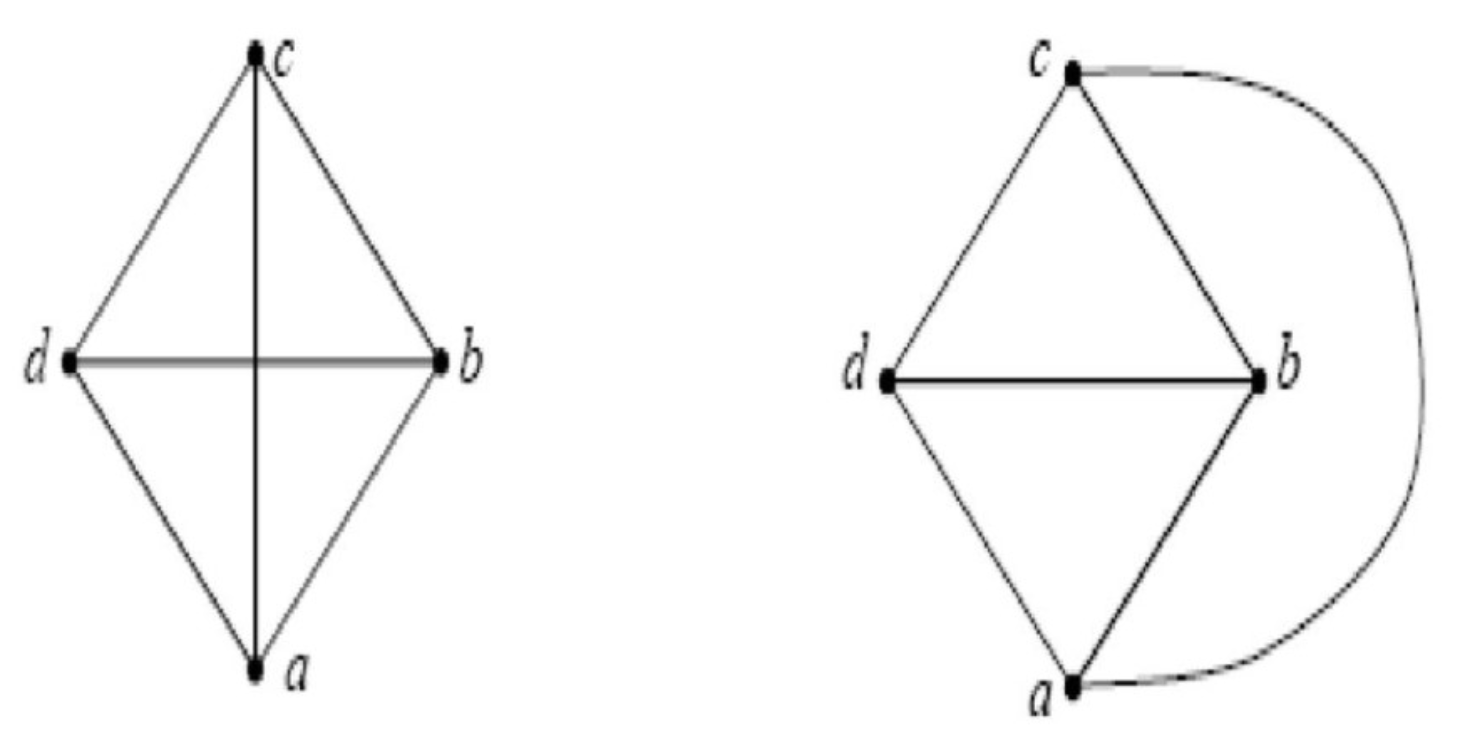
Answer:
4.12. Chromatic Number of
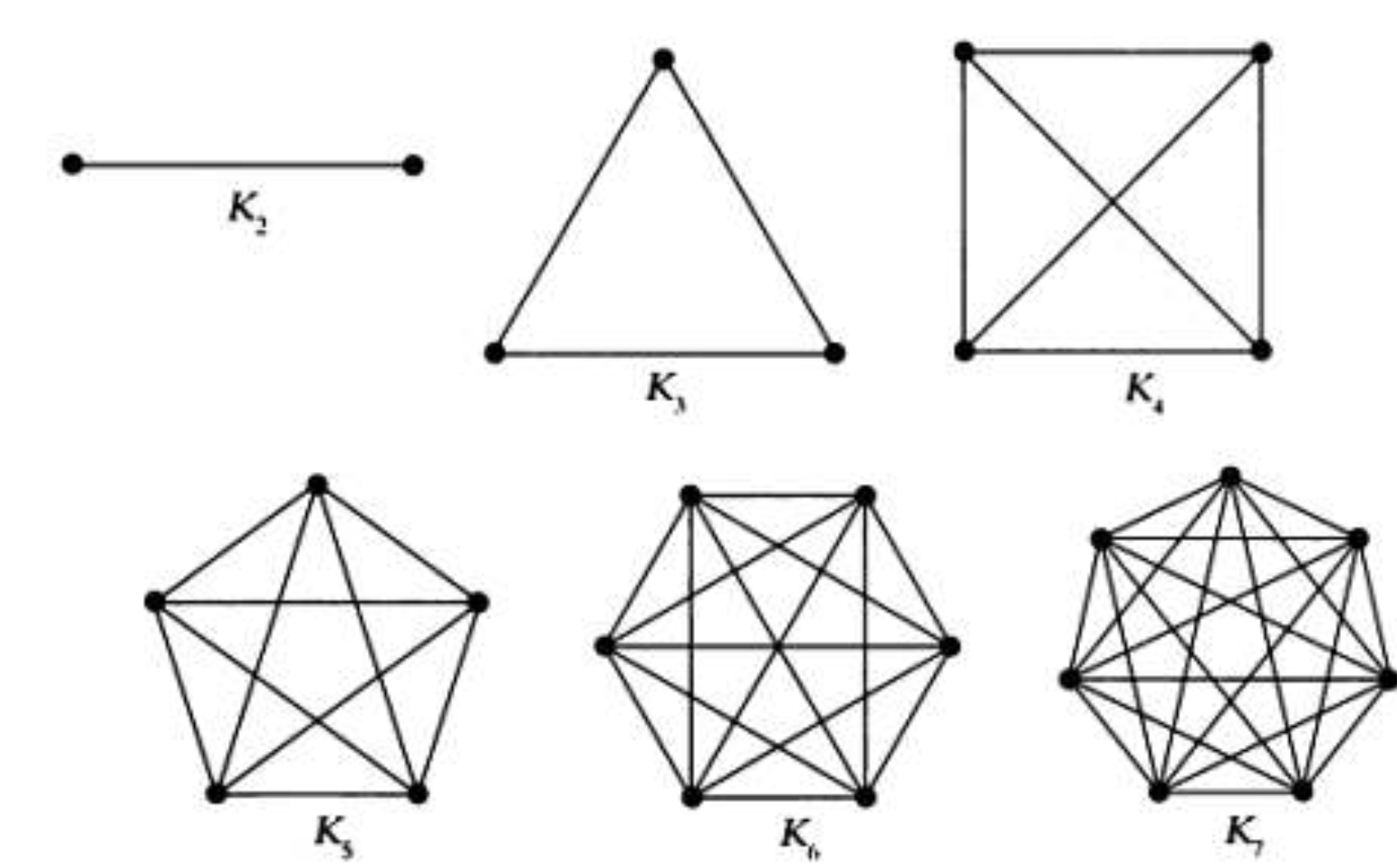
What is the chromatic number of the complete graph
Click to see the solution
Key Concept: In a complete graph, every vertex is adjacent to every other vertex.
- Structure:
- Consequence: No two vertices can share a colour.
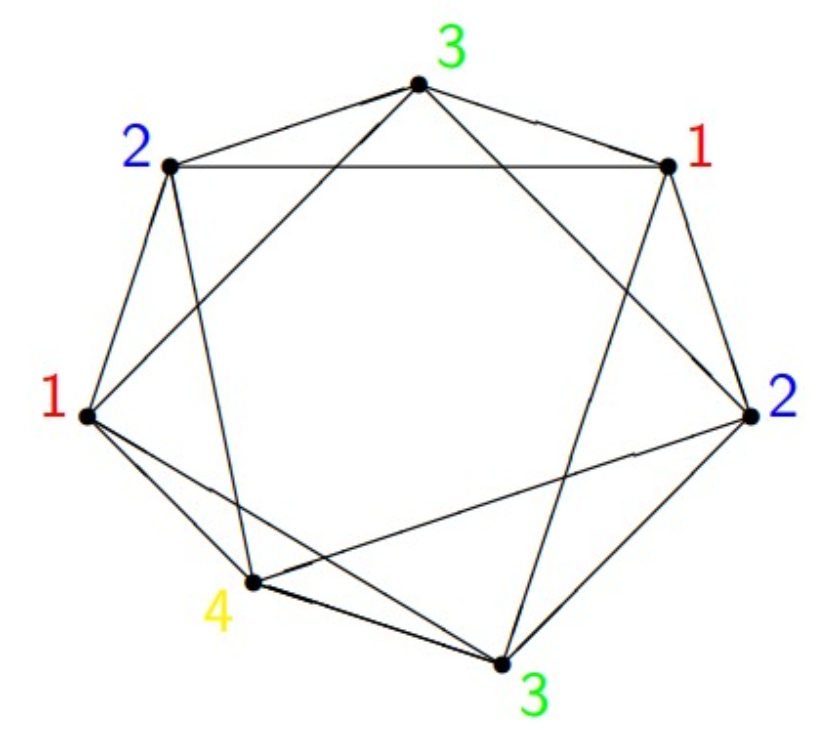
- Required colours: Each of the 4 vertices needs a distinct colour.
- Colouring:
- Vertex A = colour 1 (Red)
- Vertex B = colour 2 (Blue)
- Vertex C = colour 3 (Green)
- Vertex D = colour 4 (Yellow)
Answer:
4.13. Chromatic Number of Wheel Graph (Tutorial 11, Task 8)
What is the chromatic number of a wheel graph
Click to see the solution
Key Concept: A wheel graph
- Structure of
- Outer cycle: 7 vertices (odd cycle)
- Central hub: 1 vertex connected to all 7 outer vertices
- Total: 8 vertices
- Attempt with 3 colours:
- The outer cycle
- Colour the outer vertices: 1, 2, 1, 2, 1, 2, 3 (the 7th vertex must differ from both the 6th and the 1st)
- So outer cycle uses colours {1, 2, 3}
- The central hub is adjacent to ALL outer vertices, including vertices of colours 1, 2, and 3
- Therefore, the hub needs a 4th colour!
- The outer cycle
- 4-colouring works:
- Outer cycle: colours 1, 2, 3 distributed (e.g., 1, 2, 1, 2, 1, 2, 3)
- Central hub: colour 4
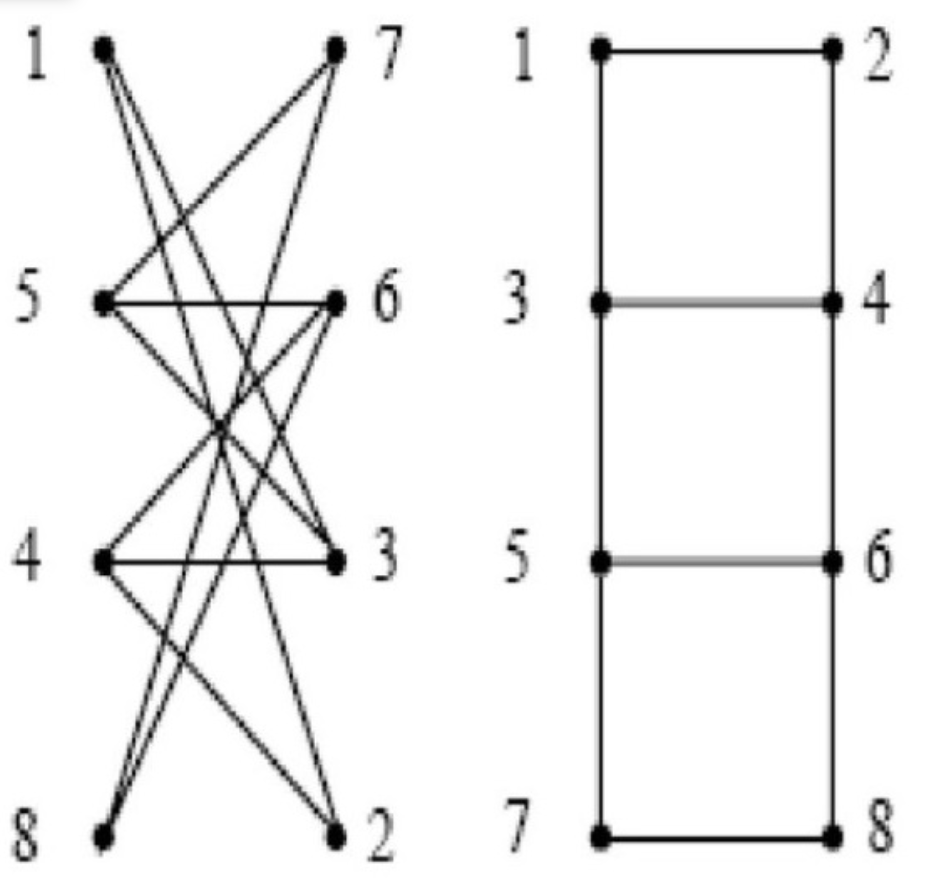
Answer: